Ardeidae
Great egret
Ardea alba
The Great Egret, Ardea alba, is a large, cosmopolitan bird commonly found in tropical and subtropical regions worldwide. In Brazil, it is a common resident species, although some populations may migrate short distances during dry seasons. Ardea alba is classified as “Least Concern” on the IUCN Red List.
General behavior
Ardea alba is generally silent but emits a harsh grunt when disturbed. It can be found in mixed colonies with other aquatic birds. During flight, the bird moves slowly, with its neck retracted, displaying graceful movements. While foraging, it uses a passive technique, standing still and waiting for prey to approach before striking rapidly with its beak.
Habitat
Ardea alba inhabits various wetland areas, such as marshes, lake and river shores, and other aquatic environments across the country. It can also be found in agricultural landscapes and occasionally in drier pastures.
Nest observation sites
The nests of Ardea alba we observed were situated in high trees of several species near the São Francisco River in Alagoas (13 nests).
Breeding season
The breeding season for Ardea alba typically occurs from June to December, in the northeastern regions of Brazil. The timing coincides with the end of the rainy season and the beginning of the dry season when food becomes more abundant.
The nest
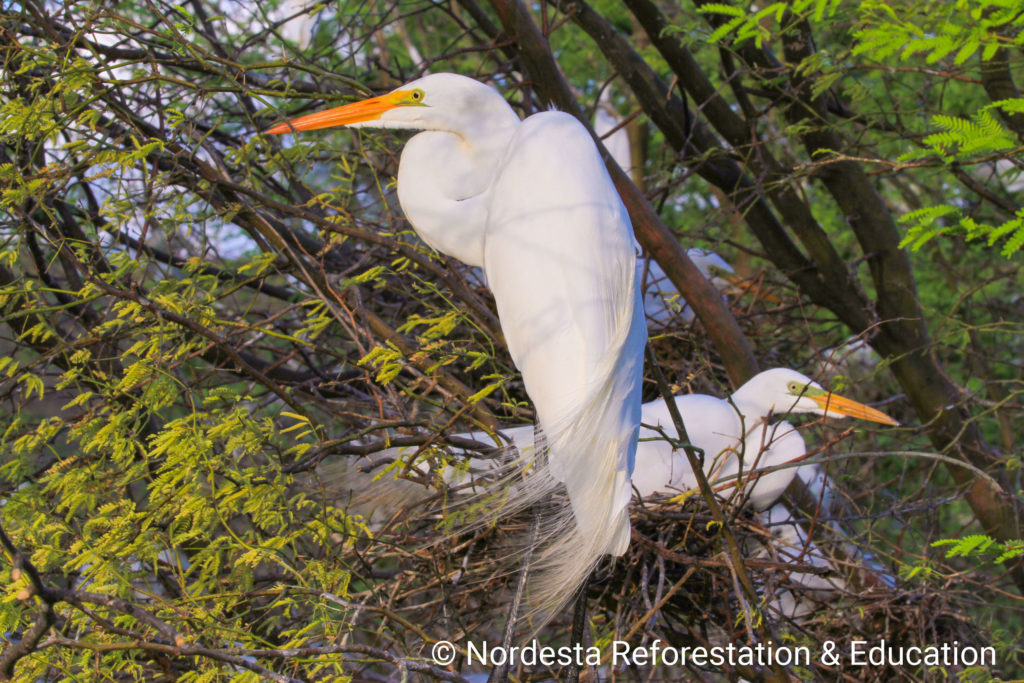
Ardea alba’s nest is a large, shallow bowl made of dry twigs lined with leaves. Nests are usually built in the higher sections of trees between 4 to 6 meters above water. These birds often nest in large colonies with other waterbird species, including the Cattle Egret Bubulcus ibis. The nests can reach up to one meter in diameter.