Corvidae
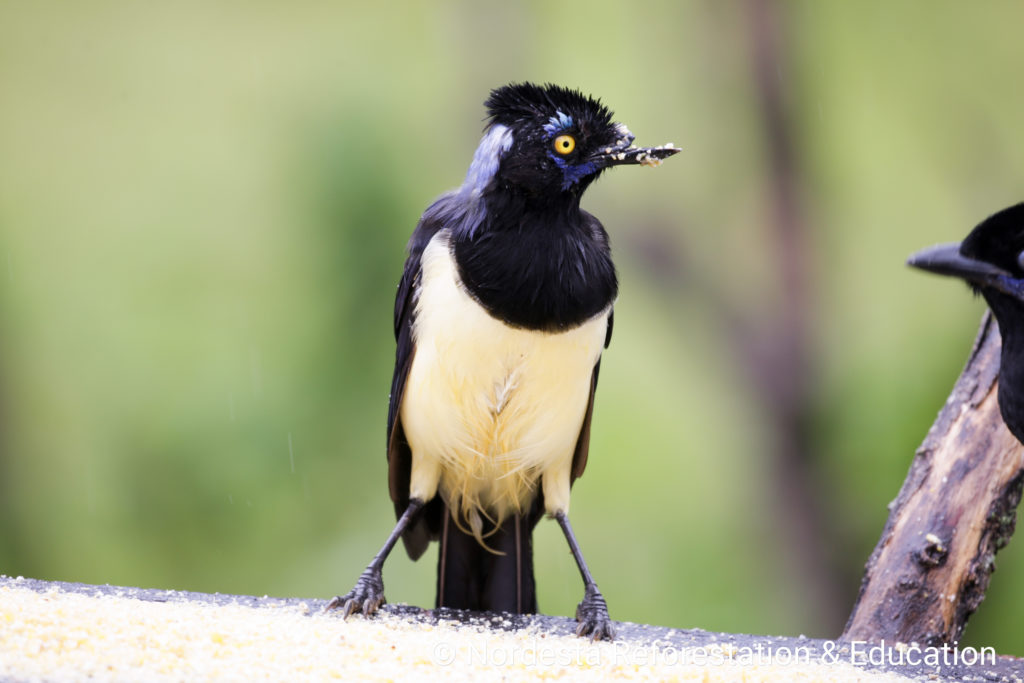
Plush-crested jay
Cyanocorax chrysops
The Cyanocorax chrysops, commonly known as the Plush-crested Jay, is a striking member of the jay family found in various regions of Brazil. It’s a non-migratory bird species that resides year-round across its distribution range.
General behavior
The Plush-crested Jay is a highly social and intelligent bird, often seen in flocks of 5 to 15 individuals. It shows practically visual differences between males and females and is known for cooperative breeding—some adults help raise the chicks of other pairs. Its diet is omnivorous, including insects, small animals, fruits, seeds, eggs, and even carrion or human food waste. Chicks are primarily fed insects.
The species is especially notable for its wide range of vocalizations. It can mimic other animals, machines, and even human voices. In the wild, it has been observed imitating raptor calls to scare away other birds and monopolize food sources.
Habitat
Cyanocorax chrysops inhabit secondary forests, especially edges and forest fragments, as well as gallery forests. Their range extends from southern Minas Gerais to southern Rio Grande do Sul, including the states of São Paulo, Paraná, and Santa Catarina. More isolated populations can also be found in Mato Grosso do Sul, Mato Grosso, Rondônia, and the southern parts of Amazonas and Pará.
Nest observation sites
We observed and recorded nests in Arcos, Minas Gerais (10 nests).
Breeding season
The breeding season varies locally but includes active nesting observed between October and December in Arcos, Minas Gerais.
The nest
The nest is a large, platform-like structure made of intertwined twigs, built at heights between 3 to 7 meters in the forest mid-story. The inner chamber is carefully lined with leaf veins, roots, and parts of the vine Aristolochia sp. Each nest may contain materials like small forked twigs (10–30 cm), longer twigs (30–50 cm) and pieces of root or vine stems.
Some nests appear fragile, with gaps between twigs visible from below. There have even been instances of eggs falling due to loosely structured edges.