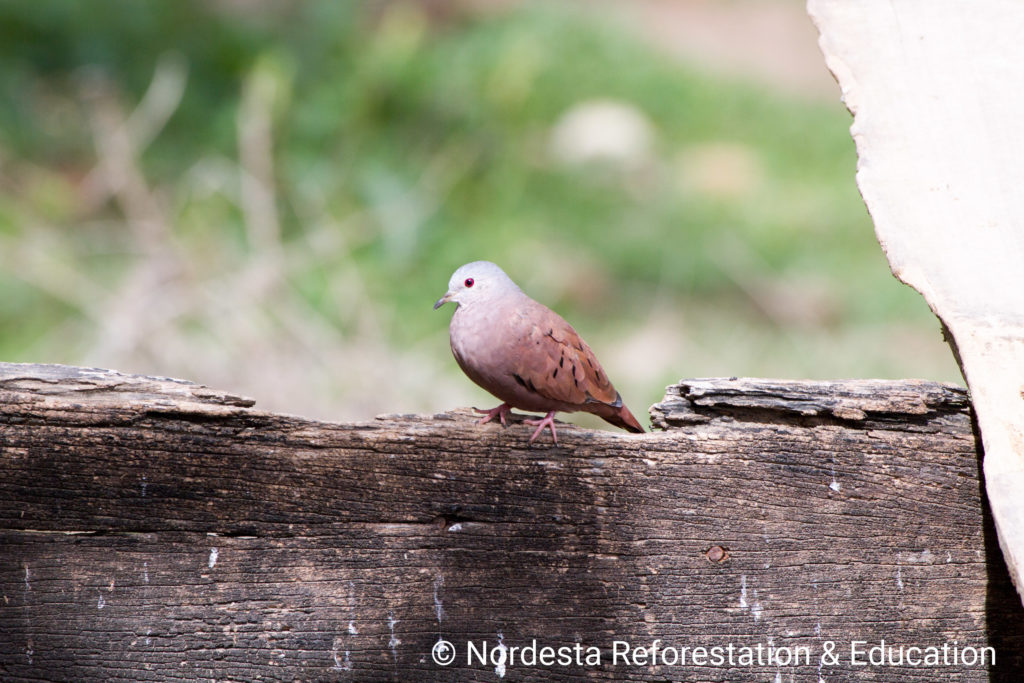
Columbidae
Ruddy ground dove
Columbina talpacoti
The Ruddy Ground Dove, Columbina talpacoti, is one of the most widespread and abundant dove species in the Americas. It ranges from the southern United States to Argentina and is commonly found across Brazil. This species thrives in various environments, including urban areas, and often benefits from human-altered landscapes like farmland and deforested zones.
General behavior
This dove is known for its adaptability and year-round breeding behaviour. Pairs often raise multiple broods in a single year, and both parents participate in building the nest, incubating the eggs, and feeding the chicks. Nestlings are cared for by both adults until they fledge, typically within two weeks.
Habitat
The Ruddy Ground Dove inhabits open and semi-open areas, including urban parks, gardens, fields, and agricultural lands. Nests are usually found in low vegetation or artificial structures, favouring locations that provide some shelter.
Nest observation sites
During field observations, we recorded 43 nests in three Brazilian municipalities: Quebrangulo, Alagoas; Arcos, Minas Gerais; and Camaçari, Bahia.
Breeding season
While breeding can occur throughout the year, activity peaks between October and February in Arcos, and April to July in Quebrangulo. Nesting times may vary based on local food availability.
The nest
Nests are shallow and cup-shaped, built mostly in shrubs or trees up to 3 meters tall, on building beams, or under roofs. Nest height ranges from 0.4 to 4.5 meters, with an average of 2.4 meters above the ground. Materials used vary greatly and include dry grass, fine roots, leaves, twigs, and occasionally man-made items like plastic, paper and strings.
Nests may be reused, and since adults don’t remove droppings, a buildup of faeces often accumulates on the nest rim.
For more information, refer to the publication: Studer, A., & Crozariol, M. A. 2023, pages 512—516, or contact the author at anita.birdaves@gmail.com
Reference:
Studer, A., & Crozariol, M. A. (2023). New breeding information on Brazilian birds. 2: Columbidae and Cuculidae. Bulletin of the British Ornithologists’ Club, 143(4), 485-553. https://doi.org/10.25226/bboc.v143i4.2023.a6.