Columbidae
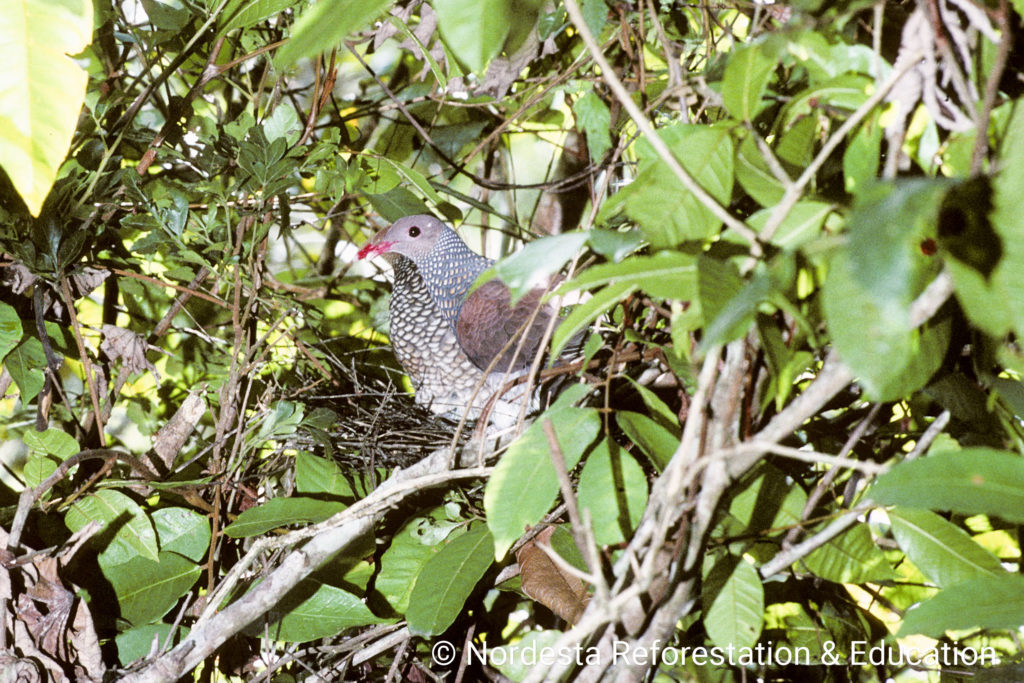
Scaled pigeon
Columba speciosa
The Scaled Pigeon, Patagioenas speciosa, is found from southern Mexico to northeast Argentina, including much of Brazil. In Brazil, it inhabits forested areas across most of the country, though it is rare or absent in the southern states and semi-arid northeast. It is more commonly found in the Atlantic Forest, Amazon, and Cerrado regions.
General behavior
Patagioenas speciosa are often seen in small groups of 3 to 5 birds, usually perched high in tree canopies or at mid-levels. They feed on fruits from trees and epiphytes. Their call is a low-pitched, two-note sound that carries over long distances and is heard more frequently at the start of the breeding season. During nesting, both parents take turns feeding the chick and keeping the nest clean, especially in the early days after hatching. They can perform a variety of defensive postures if disturbed, including inflating their chest, spreading wings, and making clicking sounds with their beak.
Habitat
This species prefers forest edges, clearings, and gallery forests. It adapts to a range of warm climates across Brazil but avoids the far south and some dry northeastern regions. It has also been observed in secondary growth and degraded habitats.
Nest observation sites
We observed nests in Quebrangulo, Alagoas (2 nests).
Breeding season
In Quebrangulo, breeding activity was recorded in April.
The nest
Scaled Pigeons build fragile, shallow platforms of twigs, often in vine tangles or near the tops of trees. The nests in Quebrangulo were located 7 and 12 meters above the ground. In other regions like Costa Rica, nests are often lower—between 0.6 and 4.5 meters—with occasional nests built as high as 18 meters or as low as ground level. The structure is typically loose and barely sufficient to support the eggs.
For more information, refer to the publication: Studer, A., & Crozariol, M. A. 2023, pages 486—487, or contact the author at anita.birdaves@gmail.com
Reference:
Studer, A., & Crozariol, M. A. (2023). New breeding information on Brazilian birds. 2: Columbidae and Cuculidae. Bulletin of the British Ornithologists’ Club, 143(4), 485-553. https://doi.org/10.25226/bboc.v143i4.2023.a6.